CS2 demo review: find one fix in 30 minutes
Review one recurring round state deeply instead of skimming an entire loss.

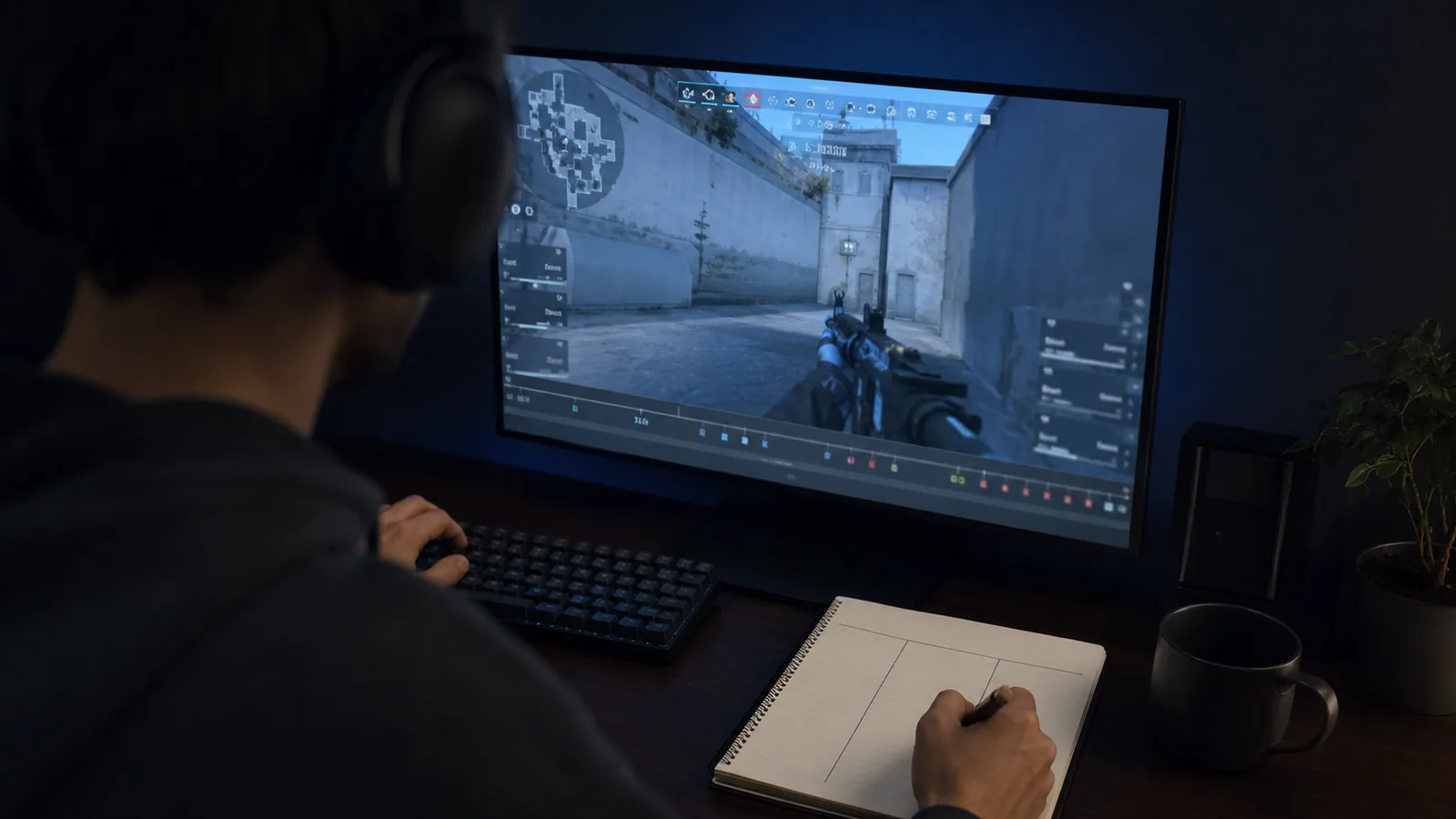
A CS2 demo contains more information than a team can use in one meeting. Trying to discuss every missed shot and rotation creates a long list with no practice priority. This 30-minute CS2 demo review narrows the work to one recurring round state, rebuilds what players knew and ends with a testable adjustment.
Minutes 0–5: choose the question
Do not begin by pressing play. Select one question from the match: Why did our B retakes start without utility? How did the opponent gain mid control on low-risk rounds? Why did our first kill fail to become a stable site? A good question appears at least twice and involves a team decision rather than one difficult duel.
Write the question at the top of three columns labelled observation, cause and next test. Keep mechanical mistakes in a separate queue unless the same positioning repeatedly creates them.
Minutes 5–15: watch only the relevant rounds
View each occurrence once from the team perspective and once from the player who owned the first decision. Pause before the mistake becomes visible. List economy, remaining grenades, known positions, time and the last communication that can be confirmed.
In the observation column, use literal descriptions: “The rotate begins before the bomb is seen.” Avoid labels such as passive or careless. Neutral language helps the team disagree about evidence without defending identity.
Minutes 15–22: compare the earliest divergence
Place the rounds beside each other and find the first moment they stop matching the team’s intended protocol. The visible death may happen fifteen seconds later. Earlier causes include an unclaimed angle, a grenade spent without replacement or two players assuming the other owns the same call.
Choose the cause that explains the most occurrences with the fewest assumptions. If the replays show different causes, narrow the original question instead of inventing one universal answer.
Minutes 22–27: write one replacement behaviour
Turn the cause into an action with an owner and trigger. “Rotator holds connector until anchor confirms two players” is teachable. “Communicate more” is not. Check the action against equipment and timing so it works in a realistic round.
If the solution belongs during a pause, compress it with our CS2 timeout protocol. If it changes preparation, connect it to the map veto plan.
Minutes 27–30: design the next test
Name the practice block that will test the behaviour and the evidence that counts as success. The team might replay the site entry five times, track whether the call occurs before a rotation or review the next scrim’s first three gun rounds. Success should be observable even when the round is lost.
Save the other observations, but do not promote them during the same meeting. A focused review respects attention as a limited resource. Thirty minutes are enough when they move one decision from accidental to explicit—and when the next session is designed to prove whether the change works.
Editorial note
Practice workflow based on Kaizensclan's decision-focused replay method.
- Counter-Strike 2 updates
- Kaizensclan Editorial Policy — editorial-policy.html
This article was reviewed on July 31, 2026.

Related stories
Path of Exile 2 Sorceress leveling guide for 0.5.4e
Path of Exile 2 Sorceress leveling is smoother when the character solves one damage loop before collecting every elemental skill. Patch 0.5.4e is the referenc.
Minecraft mace combat guide for Java 1.21.9
Minecraft mace combat turns vertical movement into damage. Java Edition 1.21.9 is the reference version. A smash attack requires striking while falling far.
Dota 2 Watcher control guide for patch 7.41e
Dota 2 Watcher control is useful when it protects the next movement, not when a support activates every structure on cooldown. Patch 7.41e is the reference.
Community channel
Join the discussion
Start a thoughtful, specific conversation about this story.
Verified readers only
Continue with Google to comment.
Your Google account creates a reader-only Kaizensclan profile. Your first comment is reviewed before publication.