CS2 angle discipline: a 30-minute practice plan
Build cleaner clearing paths, hold gaps and counter-strafes in one measurable routine.

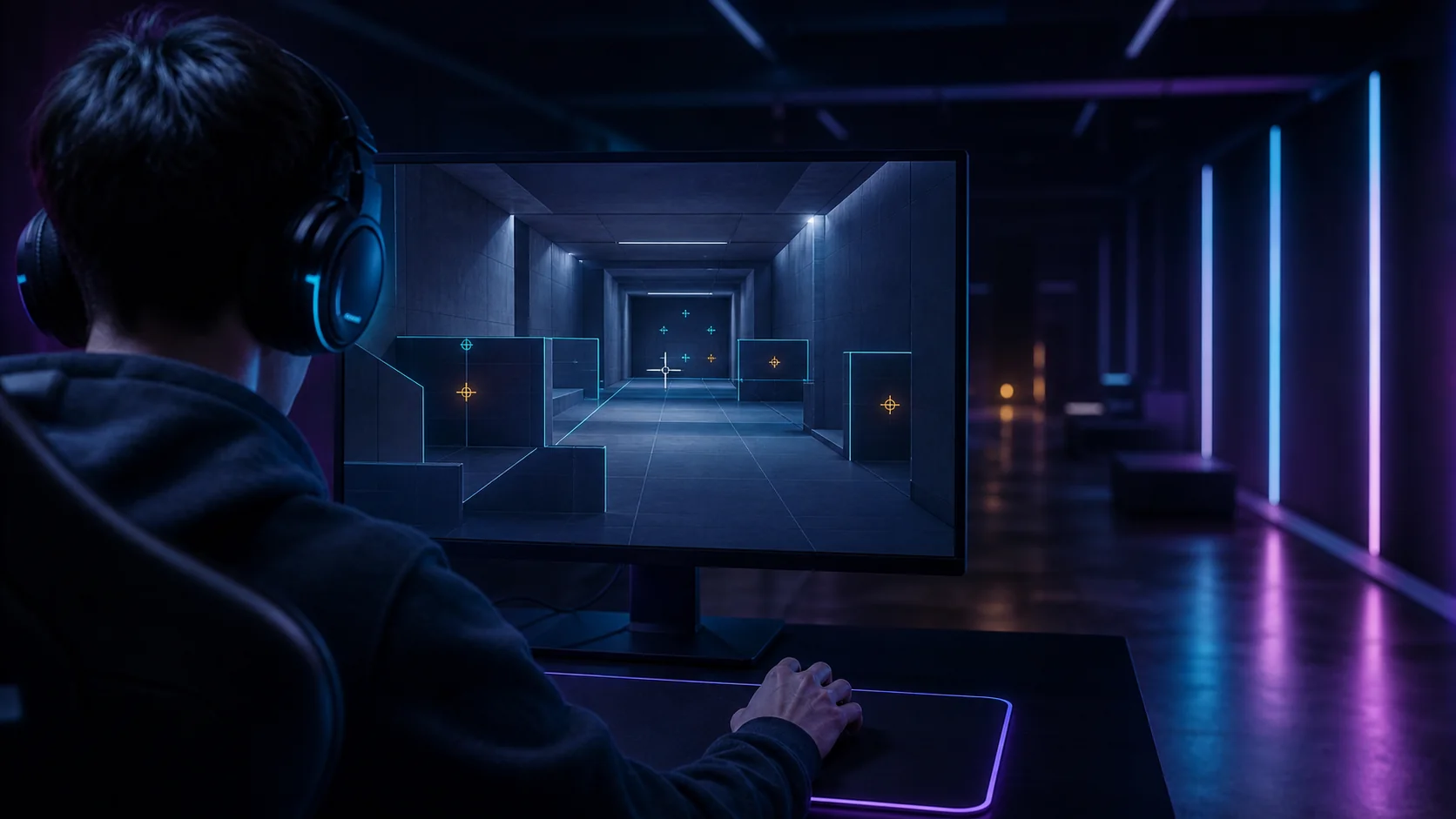
This CS2 angle discipline guide is for players who aim well in practice but lose fights before the first bullet. In one focused 30-minute session, you will build a repeatable way to clear corners, hold the correct head height and stop exposing yourself to two threats at once.
What angle discipline actually fixes
Angle discipline is the habit of making every duel as small and predictable as possible. It combines crosshair placement, distance from cover, movement timing and the order in which you expose positions. Raw aim still matters, but good geometry gives that aim a fair fight.
The most common mistake is clearing a room instead of clearing one line. Your eyes jump toward the centre while your character becomes visible to several positions. The solution is not faster flicking. It is reducing the number of places that can shoot you at any single moment.
Step 1: build a clean clearing path
- Load an empty map and choose one bomb site.
- Walk the route once without shooting. Name every position that can see you.
- Repeat the route while keeping your crosshair at head height.
- Pause before each new angle and check whether an uncleared position can also see you.
- Adjust your path until each peek reveals only one likely threat.
Move slowly for the first five minutes. Speed hides errors; a deliberate walk makes them obvious. Keep the crosshair attached to the edge you expect a model to leave, rather than dragging it through the wall or floating it into open space.
Step 2: match your crosshair gap to the peek
A close corner crosses your screen quickly, so holding one pixel from the edge invites a desperate flick. A distant angle produces slower apparent movement and rewards a tighter hold. Start with a wider gap for close swings and narrow it as the expected contact moves farther away.
Do ten repetitions at three distances. Do not count kills. Count how often the target enters your crosshair before you correct the mouse. That is the useful signal: it tells you whether your starting position matched the speed of the fight.
Step 3: separate movement from the shot
Counter-strafe only enough to make the first bullet accurate; do not turn every peek into a keyboard rhythm exercise. Strafe out, stop, confirm the target and fire a short burst. If you shoot while still drifting, reset the repetition immediately instead of rewarding a lucky hit.
Record one minute of practice. Watch the feet, not the crosshair. You are looking for extra direction changes, crouches used as panic buttons and wide swings that expose a second angle. Remove one unnecessary input on the next run.
A 30-minute routine you can repeat
- Five minutes: trace one route at walking speed.
- Ten minutes: clear the same route with a rifle and reset after every movement error.
- Five minutes: practise close, medium and long hold gaps.
- Five minutes: add one flash or smoke and preserve the same clearing order.
- Five minutes: play a deathmatch while judging only first-contact quality.
Stop after 30 minutes. Focus deteriorates before mechanics do, and another hour of careless repetitions can teach exactly the habit you came to remove.
How to measure progress
Track three numbers across a week: first-bullet attempts, deaths while visible to multiple angles and rounds in which your crosshair starts below head level. A small note after each session is enough. Accuracy percentage alone cannot tell you whether the duel was structurally good.
Use the same route for three sessions before changing maps. When the movement becomes automatic, transfer the process to a second site. Pair this routine with our guide to short, useful comms and the Nuke utility protocol when you are ready to add team play.
Common mistakes that make practice look better than it is
Do not restart only after a missed shot. Restart after a bad approach even when the shot lands. A lucky correction rewards the wrong movement, while a clean peek followed by a miss still contains useful mechanics. Separate the quality of the setup from the result.
Avoid changing crosshair, sensitivity and map in the same week. Too many variables make improvement impossible to attribute. Keep the setup stable for at least three sessions, then change one thing and compare the same route.
Finally, do not prefire every position during the main drill. Prefiring trains a planned timing; angle discipline trains a visual relationship. Use a separate block for common prefires after the clearing path remains clean without them.
Transfer the habit into ranked rounds
Choose one focus for the first five rounds: head height, single-angle exposure or stopping before the shot. Trying to monitor all three during a match overloads attention and makes the new behaviour disappear under pressure.
Between rounds, recall one duel and label it clean or crowded. “Clean” means one threat, prepared crosshair and controlled movement, regardless of who won. “Crowded” means the geometry forced a correction. That binary review takes seconds and keeps practice connected to actual decisions.
Before you queue
Warm up the decision before the mechanics. Pick the site you expect to play, name its first three angles and decide which mistake you are measuring. The routine works best when one observation survives into the match.
Do not judge the session by kill count. A lower score with cleaner first contacts is progress; a high score built on wide swings and recovery flicks is noise. Save one short clip from the start and one from the end, compare the amount of mouse correction after each peek and write a single adjustment for tomorrow. That small loop keeps practice honest and prevents a 30-minute plan from becoming an unfocused warm-up.
Sources and update note
Official Counter-Strike 2 update notes
This article was manually reviewed on July 27, 2026. Generated editorial artwork is credited to Kaizensclan.
Editorial note
- Official update notes and Kaizensclan editorial testing
This article was reviewed on July 27, 2026.

Related stories
Path of Exile 2 Sorceress leveling guide for 0.5.4e
Path of Exile 2 Sorceress leveling is smoother when the character solves one damage loop before collecting every elemental skill. Patch 0.5.4e is the referenc.
Minecraft mace combat guide for Java 1.21.9
Minecraft mace combat turns vertical movement into damage. Java Edition 1.21.9 is the reference version. A smash attack requires striking while falling far.
Dota 2 Watcher control guide for patch 7.41e
Dota 2 Watcher control is useful when it protects the next movement, not when a support activates every structure on cooldown. Patch 7.41e is the reference.
Community channel
Join the discussion
Start a thoughtful, specific conversation about this story.
Verified readers only
Continue with Google to comment.
Your Google account creates a reader-only Kaizensclan profile. Your first comment is reviewed before publication.