LoL wave resets: three decisions for every lane
Hold, build or clear: a simple framework for safer recalls and useful pressure.

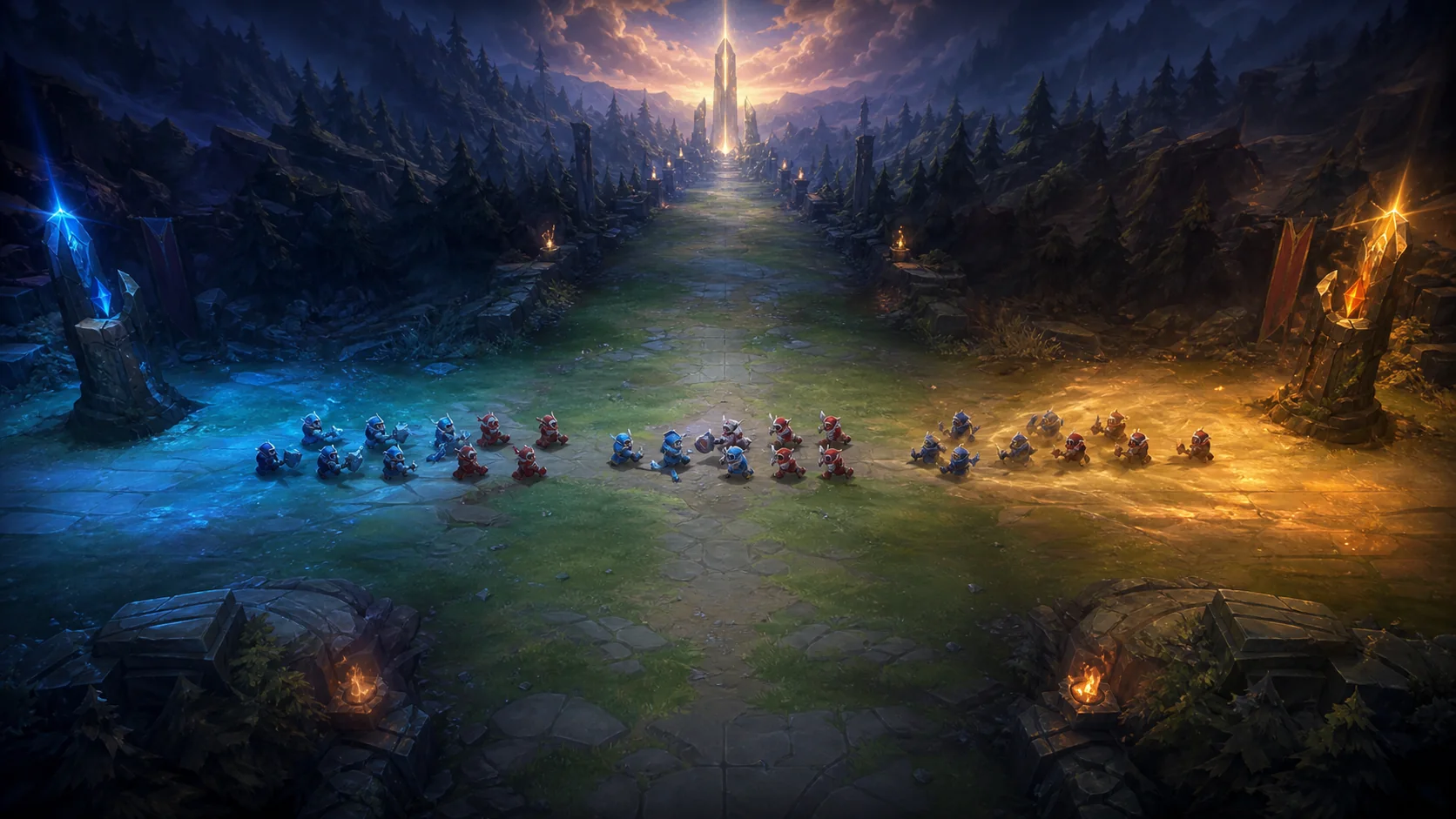
This LoL wave reset guide replaces jargon with three repeatable decisions: hold, build or clear. It is written for laners who return from base to a worse position than the one they left and want a reliable way to plan the next 60 seconds.
Start with the next wave, not the current one
The visible minions tell you what is happening now; the next wave determines whether your choice will last. Before touching the lane, compare the remaining minions, check which reinforcement wave arrives first and note whether a cannon wave is approaching. Then ask where the wave will meet after both sides finish attacking.
You do not need exact arithmetic. Count the difference, recognise which side has healthier ranged minions and include champion damage. Your goal is a useful prediction: toward you, neutral or away from you.
Decision 1: hold the wave
Hold when safety and denial matter more than immediate tempo. Remove just enough enemy damage to keep the meeting point near your side without letting the wave reach the turret. Stand where you can threaten the opponent without absorbing unnecessary minion damage.
A hold fails when the enemy can freely break it or when you need to move first for an objective. Do not protect a perfect freeze while your team contests the river without you. Wave control creates options; it should not become a reason to ignore the map.
Decision 2: build a slow push
Build when you want a larger wave to create time later. Remove a small part of the enemy wave, keep your own minions alive and allow reinforcements to stack. The resulting wave takes longer to clear and can pin an opponent while you ward, recall or move.
Start the slow push early enough for the stack to reach the turret when your team acts elsewhere. A wave that crashes 20 seconds after the objective fight is not pressure; it is cleanup for the opponent.
Decision 3: clear and reset
- Remove ranged minions first when they are safe to reach.
- Use enough resources to finish before the next enemy wave locks yours in place.
- Walk out of vision before recalling.
- Spend quickly and choose the shortest safe return path.
The reset is successful when the opponent must choose between matching your recall and losing minions, or staying and facing your item advantage. Staying for one extra plate or camp often destroys that timing.
Three questions before every recall
- Will my wave reach the enemy turret?
- Can the opponent stop my recall or hold the wave?
- What happens on the map before I return?
If you cannot answer all three, move the camera and wait two seconds. That short check prevents more bad recalls than memorising a dozen specialised lane states.
Practise without autopilot
For three games, label each major wave in chat notes or on paper: hold, build or clear. After the match, review only the moments when the result differed from the label. You will quickly find whether the mistake was your prediction, execution or a map event you ignored.
The 2026 season introduced broad systems changes, so verify role and map details in Riot’s current notes. The framework remains intentionally general. Continue with our map-reading guide for a cross-game view of wave pressure and the short comms guide for coordinating recalls.
What changes by role
Top lane has the longest punishment window after a bad reset, so preserving a safe meeting point often matters more than squeezing one extra trade. Mid lane can clear faster and influence both sides, which makes the objective clock more important. Bot lane must account for two recall timings and the support’s need to leave.
The three decisions remain the same. Only the cost of each option changes. Name the role-specific risk before choosing: a long return path, a river fight, a support roam or an exposed plate.
When the opponent breaks your plan
If the opponent adds unexpected damage, stop protecting the original label. Recalculate the next meeting point and choose again. A failed slow push can still become a clean clear; a broken hold can become a safe recall if you remove the wave quickly.
Do not chase the opponent through the lane while their minions survive. Champion pressure feels active, but the wave is what determines your next minute. Fix the state first unless the fight is certain and immediately valuable.
A simple VOD checklist
- Where did the next wave meet?
- Which side arrived first?
- Did the recall finish before an objective or roam?
- What did the opponent lose by matching it?
- Which piece of information was missing?
Review three resets, not the entire match. Focused review produces a rule you can remember in the next queue.
Before you queue
Pick one lane and commit to naming the decision before you damage the wave. You can say it aloud, type a one-letter note or mark it on paper. The act of choosing exposes autopilot before it changes the lane.
Review the first reset that produced a lost wave or bad objective timing. Pause when the decision was made, not when the loss became visible. Count minions, locate the next wave and note the map event that created urgency. Then choose again with the same information. The exercise trains prediction rather than hindsight and turns a vague “bad recall” into a rule you can carry into the next game.
Sources and update note
Riot Games: League of Legends patch notes
This article was manually reviewed on July 27, 2026. Generated editorial artwork is credited to Kaizensclan.
Editorial note
- Official update notes and Kaizensclan editorial testing
This article was reviewed on July 27, 2026.

Related stories
Path of Exile 2 Sorceress leveling guide for 0.5.4e
Path of Exile 2 Sorceress leveling is smoother when the character solves one damage loop before collecting every elemental skill. Patch 0.5.4e is the referenc.
Minecraft mace combat guide for Java 1.21.9
Minecraft mace combat turns vertical movement into damage. Java Edition 1.21.9 is the reference version. A smash attack requires striking while falling far.
Dota 2 Watcher control guide for patch 7.41e
Dota 2 Watcher control is useful when it protects the next movement, not when a support activates every structure on cooldown. Patch 7.41e is the reference.
Community channel
Join the discussion
Start a thoughtful, specific conversation about this story.
Verified readers only
Continue with Google to comment.
Your Google account creates a reader-only Kaizensclan profile. Your first comment is reviewed before publication.